
Search Website
Research Labs and Resources
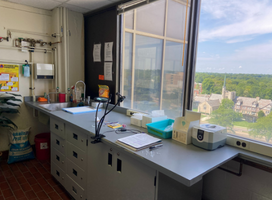
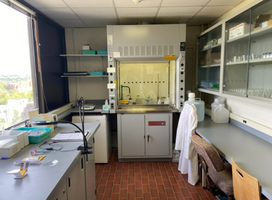
The Bioarchaeology Chemistry Lab, located in Social Science Centre (SSC), room 9322, has facilities, equipment, and supplies to process archaeological samples for biochemical analyses, including for stable isotopes (e.g., carbon, nitrogen, oxygen) and trace elements. Chemical procedures are performed in the fume hood. Equipment to prepare and process samples include a handheld Dremel tool, a precision balance, an ultrasonic cleaner, a magnetic stirrer hot plate, an adjustable desktop illuminated magnifier, a centrifuge, miscellaneous glassware and vials, and sample collection instruments including 1 and 2mm punches.
We work with the Western Laboratory for Stable Isotope Science (https://www.uwo.ca/earth/LSIS/) for the subsequent analyses (e.g. mass spectrometry) of prepared samples.
The Bioarchaeology Teaching Laboratory, located Social Science Centre (SSC), room 2257, can accommodate up to 50 students and incorporates built in audiovisual/computer equipment. The lab is home to our extensive artefactual, skeletal and hominid fossil cast collection and includes over 500 items. The lab contains two annexes which contain our Zooarchaeological teaching collection and the Human Osteological collection.
The Digital & Interdisciplinary Archaeology Lab (DIA Lab), located in Social Science Centre (SSC) room 3430, centers several core strengths of the Department of Anthropology at Western: digital archaeology, geophysical survey and mapping, community-based approaches, and interdisciplinary research. The lab offers a meeting and workspace for students, as well as resources for projects that combine archaeology, anthropology, digital humanities, geography, and other fields to explore issues related to heritage and the built landscape, past and present. As a community, we share and workshop ideas and methods, share resources, collaborate on projects, and mobilize research at conferences and in community.
Resources include:
- 3D printing station and software
- Small equipment library (e.g., H4N digital recorder, Canon EOS cameras, document scanners, field iPads)
- Small drones for photogrammetry and survey
- Computer stations with photogrammetry, GIS, geophysical, and photo editing software
- Historic material teaching collections
Learn about lab hours, hands-on learning opportunities, updates, and research on our Hub Site.
The Human Osteology Teaching Collection, housed in Social Science Centre (SSC) room 2257B, contains over 50 medical specimens, casts and archaeological material of European ancestry that include a wide range of ages, sex and pathologies. Also included are numerous casts for teaching age and sex determination including Suchey-Webb epiphyseal union, pubic age, rib age, dental development and Suchey-Sutherland pubic sex casts.
The PAVE LAB, located in Social Science Centre (SSC) 3254B, is a lab where the group of researchers broadly focuses on variation in the human phenotype. Many research projects originate from bioarchaeology and palaeoanthropology, and involve trying to understand the mechanisms that drove the evolution and adaptability of our species.
For more information, visit: PAVE LAB
The Western Ethnography Collaboratory (WE-ColLab), located in Social Science Centre (SSC) room 3315, is a dedicated ethnography lab and drop in space for students, researchers and community members. During drop in sessions, participants can explore human experiences, share ideas, discuss qualitative methods and collaborte across disciplines. Both beginners and experienced researchers interested in ethnographic research are welcome.
You can find updates and announcements via the WE-ColLab Instagram
The Zooarchaeology Teaching Collection, housed in Social Science Centre (SSC) room 2257A, includes over 400 animal skeletons with specific focus on species from Ontario and the Arctic.
Other campus resources that can be accessed by members of the Anthropology Department include:
Laboratory for Stable Isotope Science (Department of Earth Sciences)
Bone and Joint Institute
Genomics Facility (Robarts Research Centre)
Time of Flight Secondary Ion Mass Spectrometry (TOF/SIMS)
Materials Analysis (Department of Chemistry)
Global Information/Global Positioning (GI/GPS) Facility in Geography
Surface Science Western
Off Campus Resources
The Museum of Ontario Archaeology is one of the three largest and most significant "Research Institutes" at Western and houses one of the largest, as well as best documented, archaeological collections from Ontario. In addition to extensive lab facilities and equipment for analysis the Museum houses a library that has many rare archaeology books and manuscripts. The Museum is located in northwest London next to the Lawson prehistoric village, a large 15th Century Neutral Iroquoian village that has been declared of provincial and national significance.
The Museum's facilities are home to a wide range of equipment available to Western’s students and faculty including:
Ground Penetrating Radar
Dual Array Magnetic Gradiometer
Resistivity Meter
Flotation Machine
Nikon XT 225 Micro-CT Scanner
3D Scanners- White Light
3D Scanner- Red Laser
3D Printer
Photography Stations
Stereoscopic Microscope