
Search Website
Teaching and Learning Resources for Secondary School Teachers and Students
Teaching and Learning Resources for Secondary School Teachers and Students
Teaching and Learning Resources for Secondary School Teachers and Students
Teaching and Learning Resources for Secondary School Teachers and Students
Our students don't just study the world - they interpret it, question it, and share it. Browse the projects below to see the kind of work happening across our courses and research opportunities. From podcasts to artwork to interactive games, these projects reflect the creativity and curiosity at the heart of our program.
Listen to students explore anthropological questions through interviews, storytelling, and personal reflection.
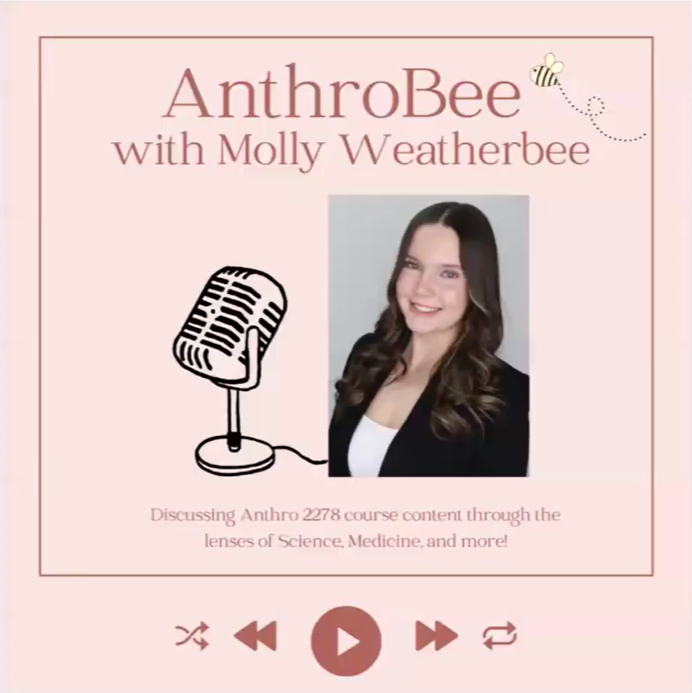 |
The Misuse of Science to Justify RacismAnthroBee by Molly WeatherbeeIn this episode of Anthrobee, Molly examines how science has historically been misused to justify racist beliefs - from Samuel Morton's craniometry to the Tuskegee Syphilis Study. Drawing on course material and a New England Journal of Medicine article on race and genomics, she makes the case that race is a social category, not a biological one, and that treating it otherwise in medicine can cause real harm. |
 |
Race, Sports, DEI, and White Supremacist GeneticsWilliam Butler's PodcastsThree episodes tackling race from unexpected angles: the myth of racial predetermination in sports, whether DEI practices actually deliver on their promises, and how white supremacists turn to genetics to assert racial purity - only to reject the results when they don't confirm what they believe. Sports and Race | Diversity, Equity, and Inclusion | White Supremacy and Genetics |
|
Race, Power, and Inequality: Connecting Anthropology to the Real WorldDecoded by Sashawna NobleA nine-episode series connecting anthropology course material to real-world systems of race, power, and inequality - covering topics from the origins of biological race and eugenics to environmental racism, race-based medicine, systemic policing, and what it means to navigate university as a racialized student. How the Idea of Biological Race Started | Race Is Not Genetic | Eugenics | Race-Based Medicine | Environmental Racism and Climate Change | University as a Racialized Student | How Race, Genetics, and Racism Shape the Way We See Humanity | Racism | The Everyday Realities of Systemic Racism | Race and Athletic Ability |
 |
Race, Ethnicity, and Identity Through a Personal LensInherited Narratives by Si-Eun ParkA ten-episode series in which Si-Eun reflects on weekly course topics in anthropology, exploring race, ethnicity, and identity beyond the classroom through her own research and perspective. |
 |
How Race Was Constructed: From Colonial Science to WhitenessCollective Learning by Leela Sophia Lata SinhaA podcast series tracing how race was constructed - from Morton's skull measurements and colonial law to the invention of whiteness and what it means to resist racial hierarchy today - woven together with Leela's own experiences growing up as a person of color in Toronto. |
 |
Racial Injustice in Canada: Eugenics, Incarceration, DNA Testing, and Health DataBeyond the Binary by Zaynab ChaudhryA three-episode series examining racial injustice close to home - from the eugenic roots of Canadian university mental health programs and the over-incarceration of Indigenous peoples, to how DNA ancestry tests can reinforce racial essentialism and why Canada's lack of race-based health data keeps disparities hidden. |
Student-designed posters examining material culture, identity, and race through an anthropological lens.
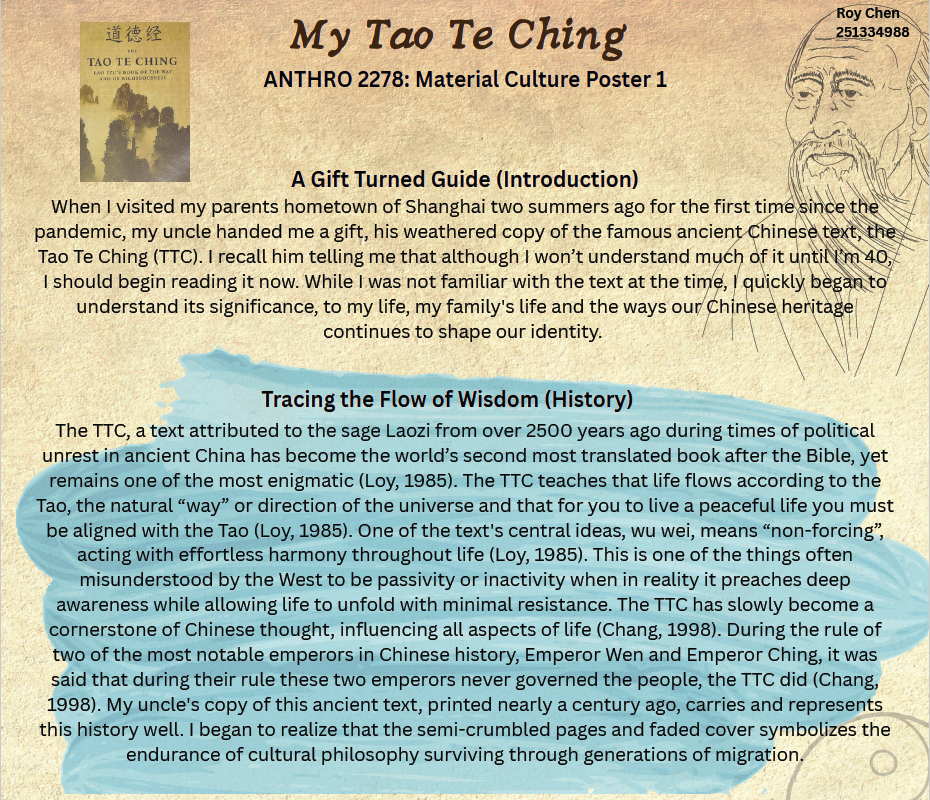 |
Bicultural Identity and Taoist PhilosophyMy Tao Te Ching by Roy ChenRoy's poster explores the Tao Te Ching - the ancient Chinese text gifted to him by his uncle in Shanghai - as a lens for understanding identity, race, and belonging. Drawing on the text's philosophy of effortless harmony, he reflects on growing up Chinese-Canadian between two value systems, and how Taoist thought helped him see his bicultural identity not as a contradiction, but as a natural flow between opposites. |
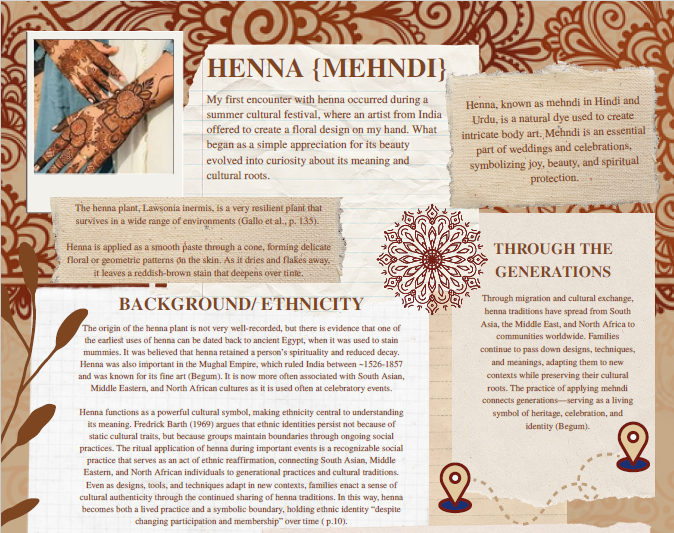 |
Henna as a Racialized Cultural MarkerHenna by Leah R Van BrenkLeah's poster examines henna (mehndi) as a material object that sits at the intersection of ethnicity, race, and identity. Tracing the practice from ancient Egypt through the Mughal Empire to its spread across South Asian, Middle Eastern, and North African communities today, she explores how henna functions as both a living ethnic boundary and a racialized marker - celebrated as "boho" aesthetic on white bodies, yet read as foreign on racialized ones. |
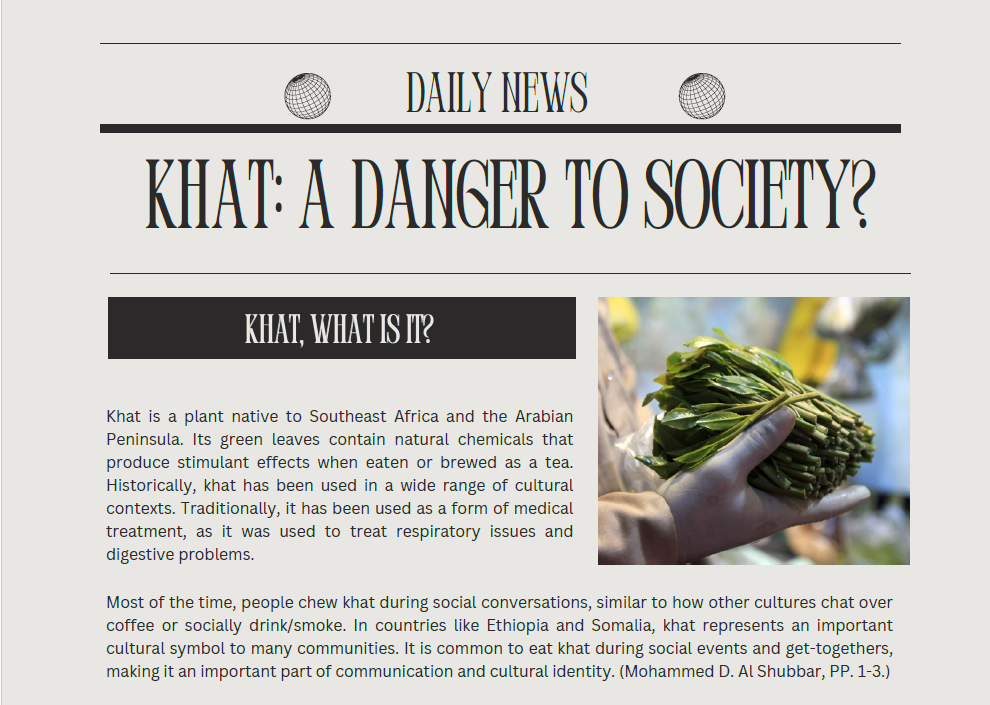 |
The Racial Politics of Drug Criminalization in CanadaKhat: A Danger To Society? by Titus ThomasTitus's poster examines the criminalization of khat in Canada - a plant used socially and culturally in Ethiopian and Somali communities - asking why it was banned when substances with similar harms remain legal. Tracing Canada's history of racially motivated drug laws from the 1908 opium ban to the 1997 Controlled Drugs and Substances Act, he argues that khat's prohibition was less about public health and more about controlling a new immigrant community's cultural practices. See Full Poster |
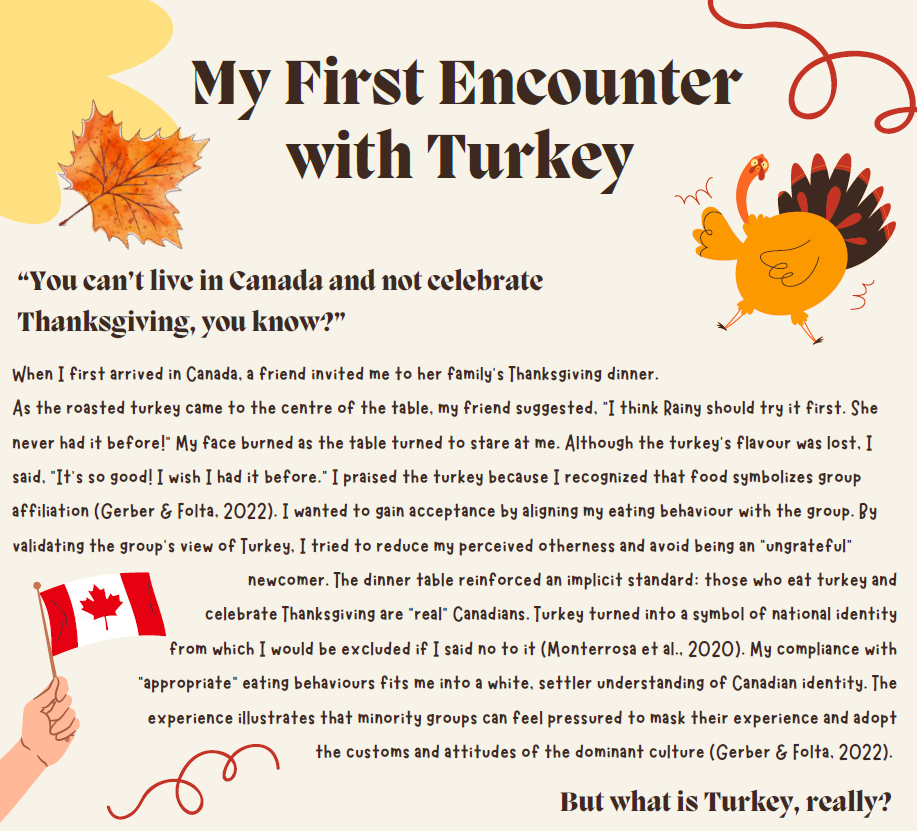 |
Food, Belonging, and Colonial Identity at ThanksgivingMy First Encounter with Turkey by Rainy LuRainy's poster reflects on her first Thanksgiving in Canada - the moment a friend put her on the spot to try turkey - and what that experience revealed about food, belonging, and colonial identity. She traces the myth of a peaceful Pilgrim feast to its violent origins, and responds by bringing a whole steamed fish to the table instead, turning a moment of pressured assimilation into what she calls "Truthgiving": a way to honour her Chinese heritage while acknowledging the land and its Indigenous history. See Full Poster |
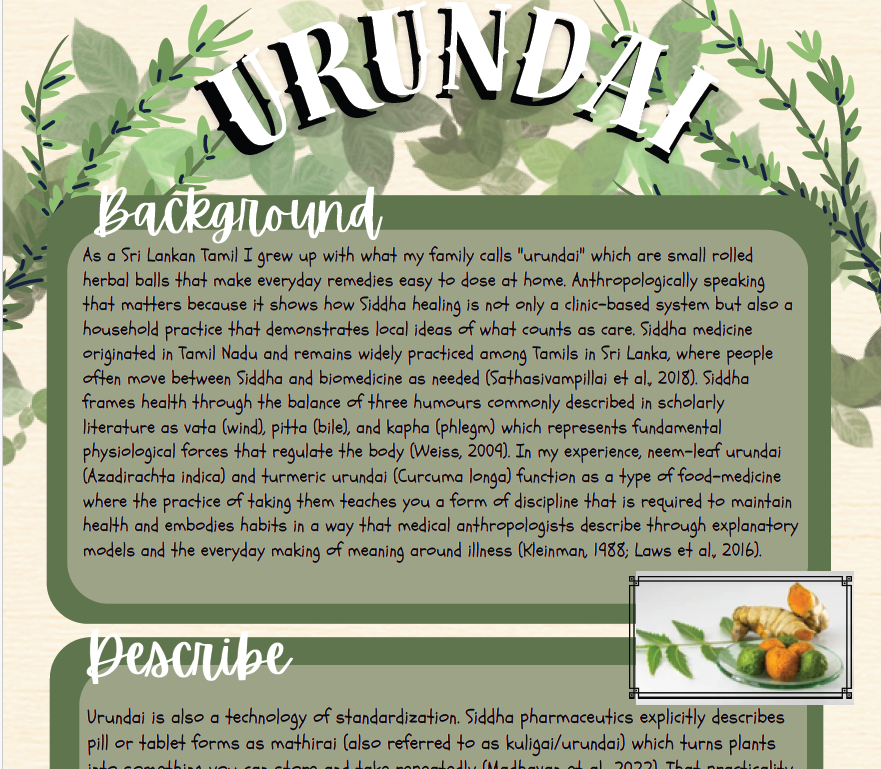 |
Traditional Medicine as Cultural CareUrundai by Varuni ThamlalingamVaruni's poster explores urundai - small rolled herbal balls used in Tamil Siddha medicine - as both a family practice and a window into how culture shapes healing. Drawing on her own experience as a Sri Lankan Tamil, including a vivid memory of reluctantly eating turmeric urundai during her first period ceremony, she connects the practice to medical pluralism, rites of passage, and the intersection of biological, social, and cultural meaning in everyday care. See Full Poster See References |
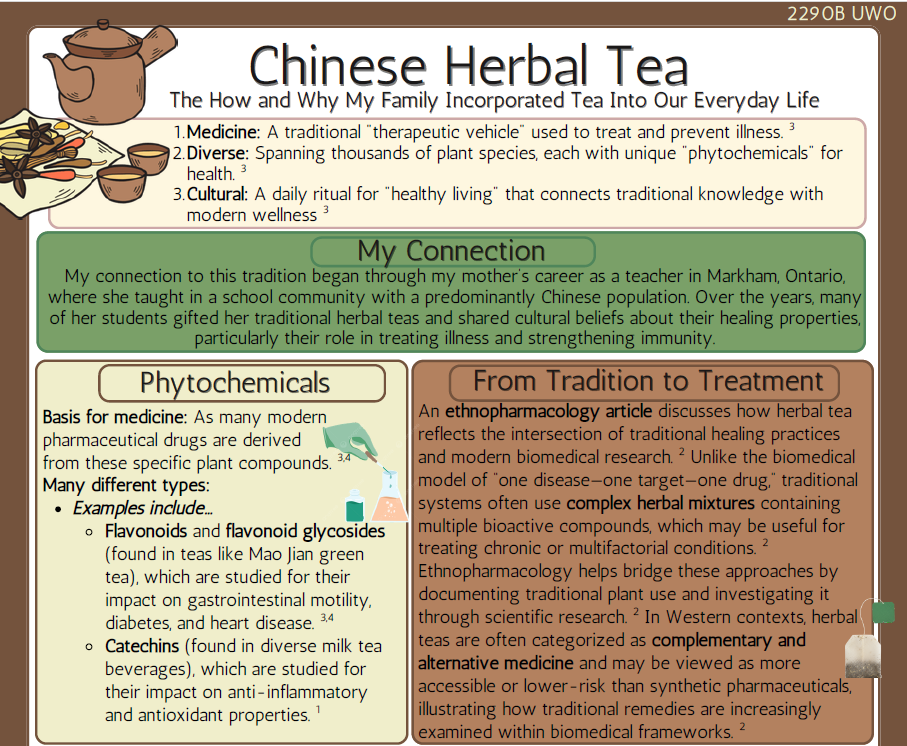 |
Chinese Herbal Tea as Healing and Cultural RitualChinese Herbal Tea by Eden SharonEden's poster explores the role of Chinese herbal tea as both a traditional healing practice and a meaningful cultural ritual. It highlights the pharmacological basis of herbal ingredients, emphasizing key phytochemicals and their therapeutic potential, while also examining how these practices intersect with modern biomedical approaches. Through a personal lens, the work illustrates how herbal tea functions not only as medicine but also as a form of care, connection, and cultural continuity within everyday life. See Full Poster |
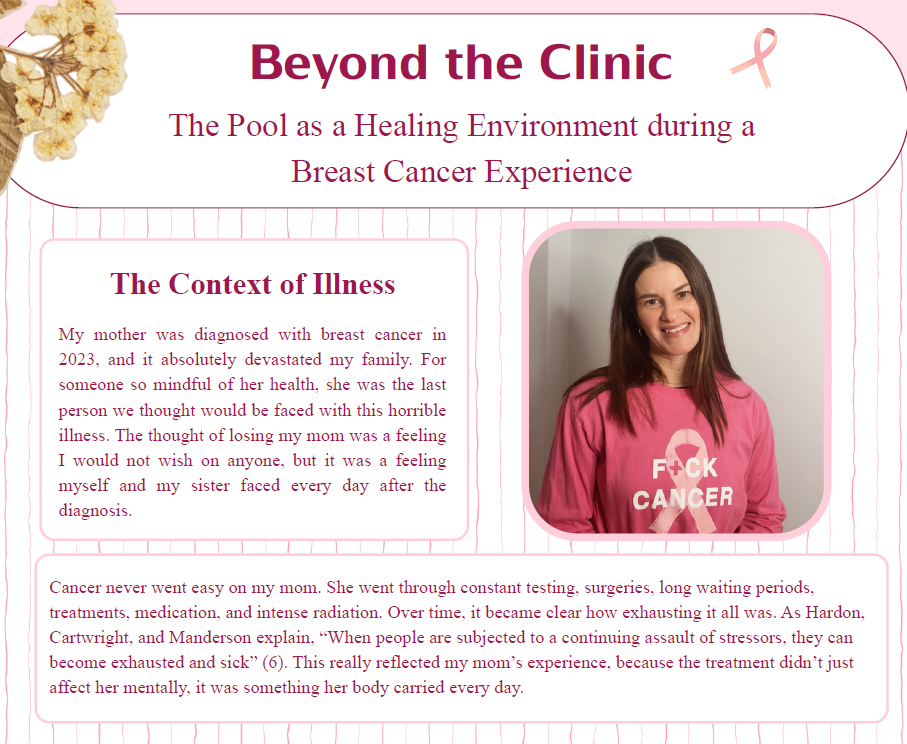 |
Healing Beyond the HospitalBeyond the Clinic by Evelyn ZammitEvelyn's poster reflects on her mother's breast cancer diagnosis and the unexpected role their backyard pool played in the family's healing. Drawing on medical anthropology - from Kleinman's concept of illness shaping life trajectories to Csordas's idea that emotional relief is physically felt in the spaces we inhabit - she explores how a familiar, everyday space became a place to cry, laugh, recover, and hold onto normalcy when illness threatened to take over everything. See Full Poster |
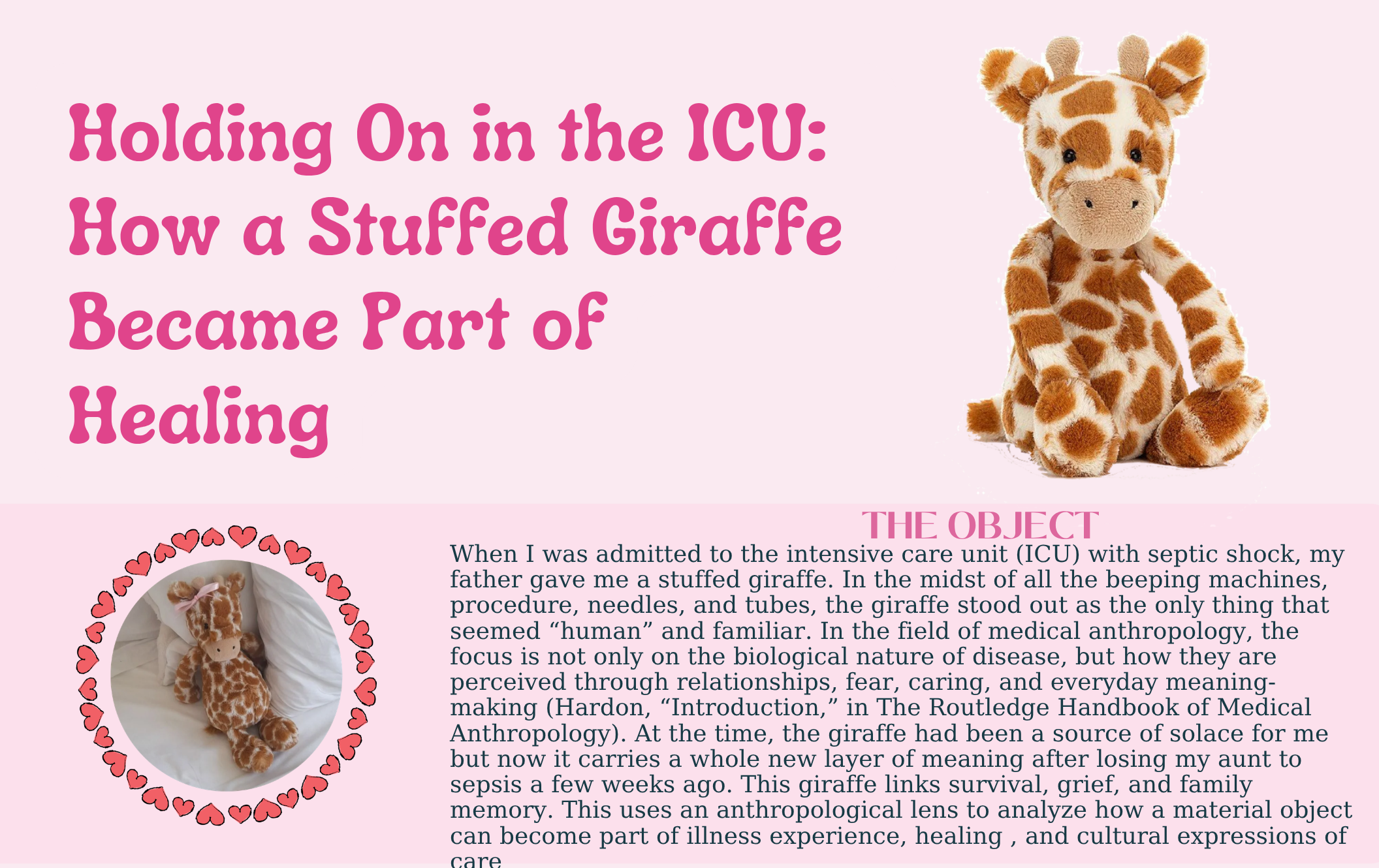 |
Healing Beyond MedicineHolding On in the ICU by Anca Basescu-CerkezAnca's poster reflects on her own experience surviving septic shock in the ICU, and how a stuffed giraffe gifted by her father became an unexpected anchor during recovery. Drawing on medical anthropology's understanding of illness, care, and healing, she explores how an ordinary object can carry emotional weight far beyond its physical form - and how true recovery involves comfort, familiarity, and human connection just as much as medical treatment. |
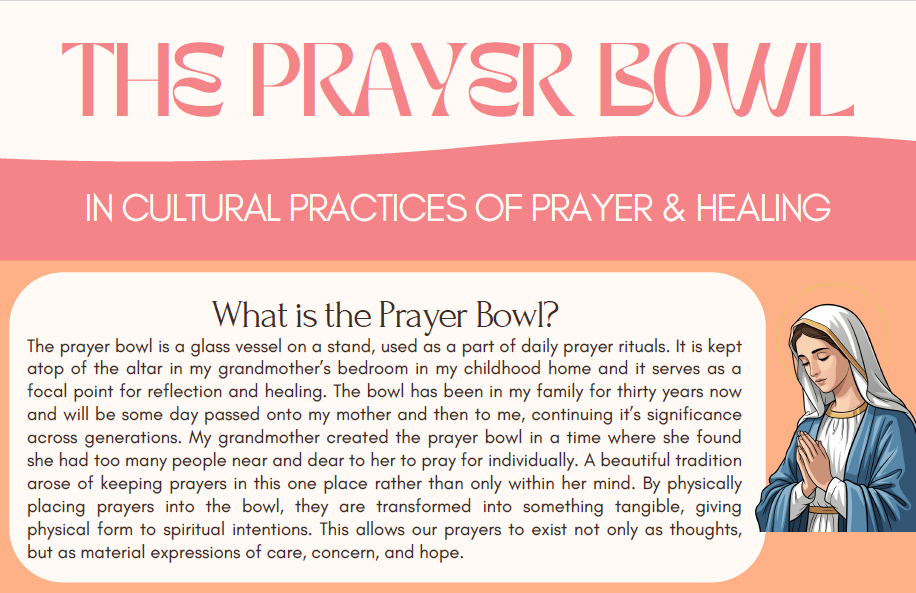 |
Prayer, Ritual, and Holistic HealingThe Prayer Bowl by Malaina ChoyMalaina's poster explores a glass prayer bowl created by her grandmother thirty years ago - a family heirloom kept on a bedroom altar where written prayers are placed for those in need of healing, protection, and comfort. Drawing on medical anthropology's distinction between disease and illness, and the concept of symbolic healing, she examines how this quiet ritual addresses the emotional and spiritual dimensions of health that biomedical treatment alone cannot reach - and how an object passed across generations can carry an entire family's understanding of what it means to heal. |
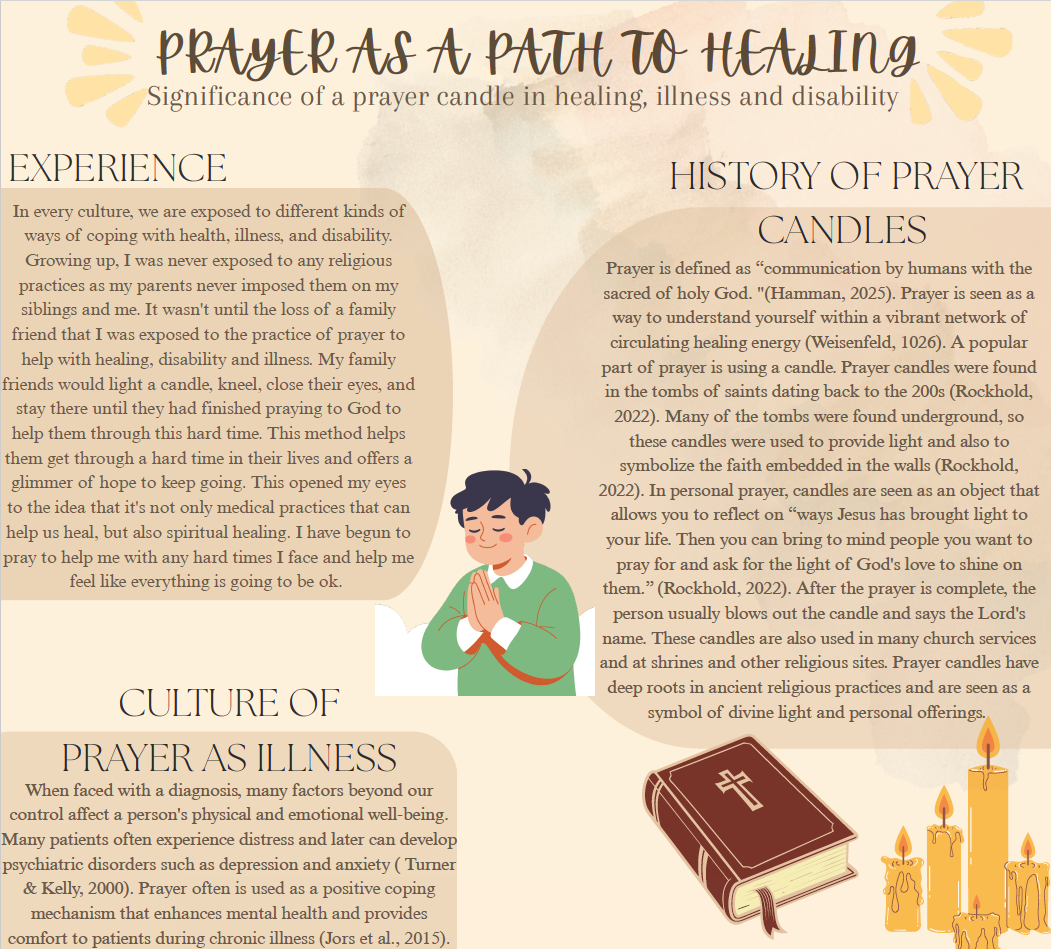 |
Faith, Flame, and HealingPrayer as a Path to Healing by Paulina SolorzanoPaulina's poster examines the prayer candle as a spiritual healing practice - tracing its roots from early Christian tombs to its role in personal prayer today. Prompted by the loss of a family friend and watching her loved ones find comfort in lighting a candle and praying through grief, Paulina draws on medical anthropology and health research to explore how prayer functions as a coping mechanism during chronic illness, disability, and loss - addressing the emotional and spiritual dimensions of health that medicine alone cannot reach. |
A collection of student work spanning infographics, illustrations, comics, websites, digital scrapbooks, and more - each using a different creative format to explore course themes.
 |
Race as Structure: A Six-Part Artistic Response
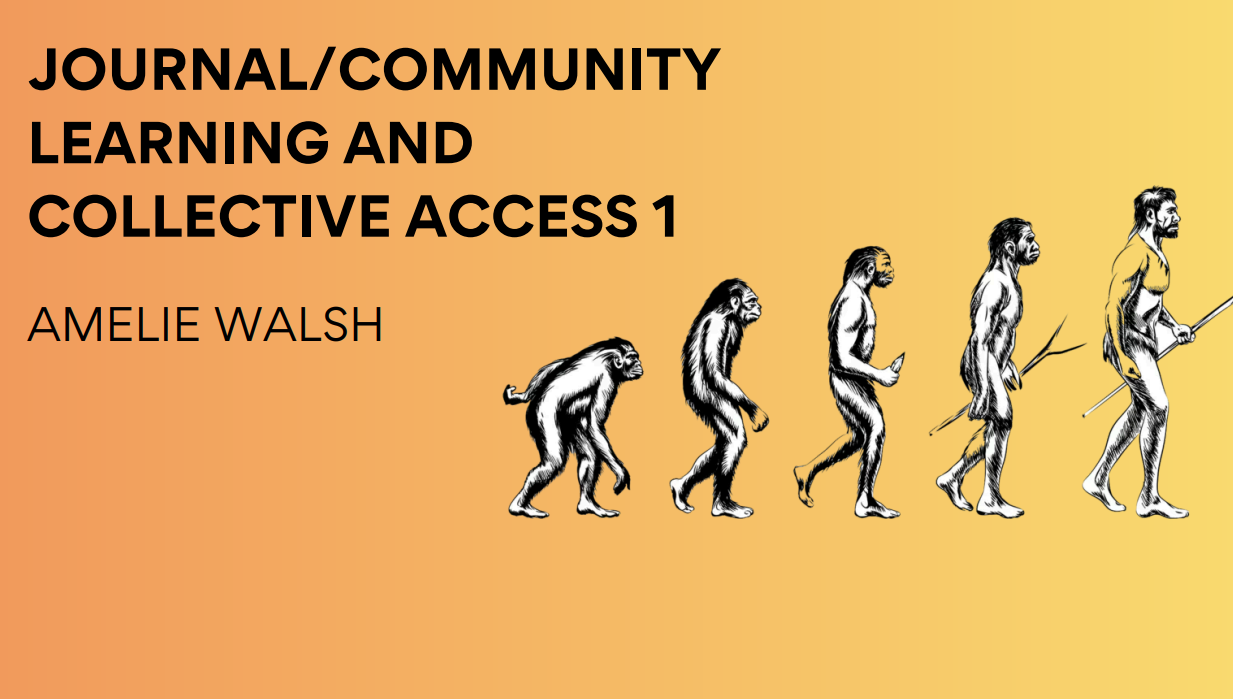
Community Learning and Collective Access by Amelie WalshIn this six-piece visual journal for ANTH 2278, Amelie responds to each week's readings from Racism, Not Race by Joseph L. Graves through original drawings - each created in a different medium, from watercolour and graphite to digital illustration and acrylic paint. The works move through the course's core themes: the social construction of race, the pseudoscience of eugenics, the politics of genetic classification, the four types of racism, racial disparities in medicine, and the 1936 Olympics. Together they form a cohesive artistic argument that race is not biological but structural - rendered not in words, but in line, colour, and form. |
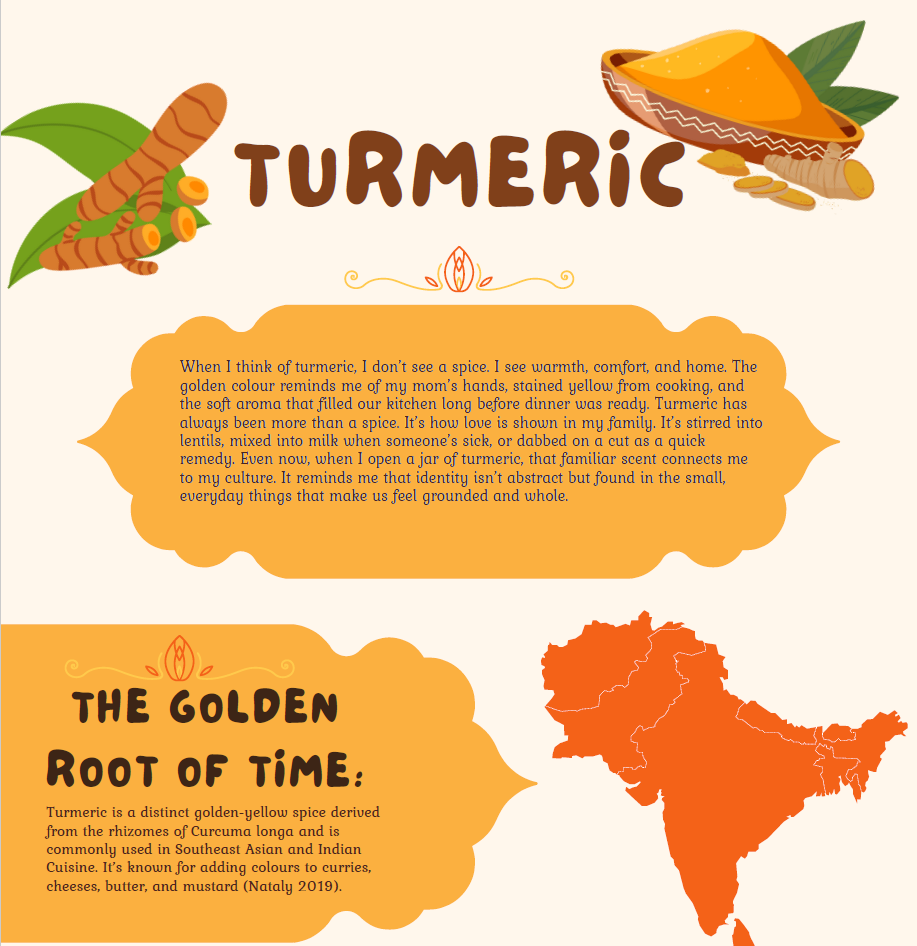 |
Turmeric, Colonialism, and Cultural IdentityTurmeric by Humaira MohmedHumaira's infographic traces turmeric's 4,000-year journey from ancient Ayurvedic medicine to South Asian kitchens to trendy café menus - and asks what is lost along the way. Weaving together personal memories of her mother's cooking and Sunday skin rituals with the history of colonial spice extraction, she reclaims turmeric not as a wellness trend but as a living thread of cultural identity. |
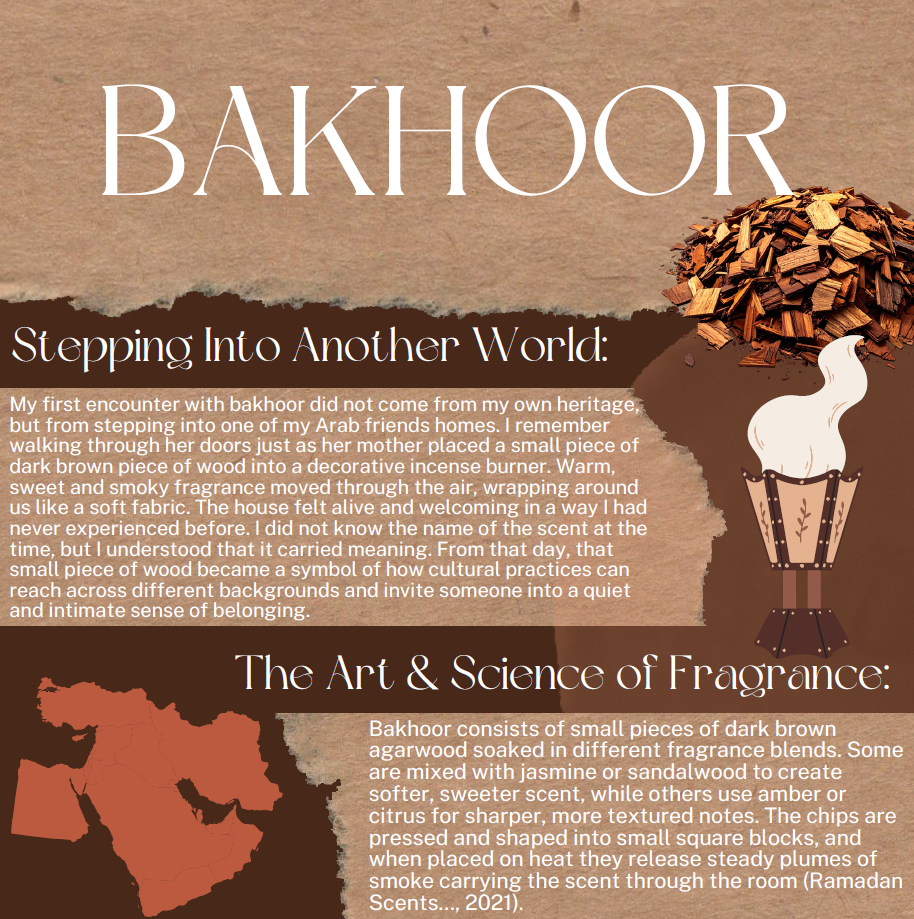 |
Bakhoor as a Sensory Vessel for HeritageBakhoor by Humaira MohmedHumaira's infographic explores bakhoor - the aromatic incense burned in many Middle Eastern and North African homes - through the lens of ethnicity and identity. Drawing on her first experience walking into a friend's home and encountering its warm, smoky scent, she examines how bakhoor functions as a sensory vessel for heritage, hospitality, and memory, and how traditions like it are too often dismissed as exotic by outsiders unfamiliar with their meaning. |
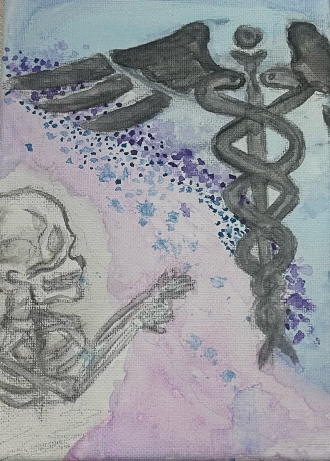 |
Race, Bias, and History Through Mixed-Media ArtLearning with Art in Different Mediums by Nevaeh ChinIn this six-piece visual journal for ANTH 2278, Nevaeh responds to each week's readings from Racism, Not Race by Joseph L. Graves through original artwork - each piece created in a deliberately different medium, from watercolour and graphite pencil to digital drawing, acrylic paint, pencil crayon, and marker. The works move through the course's core themes: implicit bias in medicine, the racial taxonomies of Linnaeus, genetic diversity rooted in Africa, the interconnected types of racism, the racialized spirometer still used in clinical care today, and Jesse Owens' charged victory at the 1936 Berlin Olympics. Across every piece, Nevaeh lets the medium carry meaning - soft watercolour for unconscious bias, smudged graphite for overlapping systems - turning each drawing into both a reflection and an argument. |
 |
Anthropology Expanded: A Personal Research BlogAnthropology in Context by Lia SaifA two-part blog created for ANTH 2278, in which Lia selects a topic from each week's course material and expands on it through her own research and reflection - published as a series of blog posts on Wix. Visit Website (first half of course) | Visit Website (second half of course) |
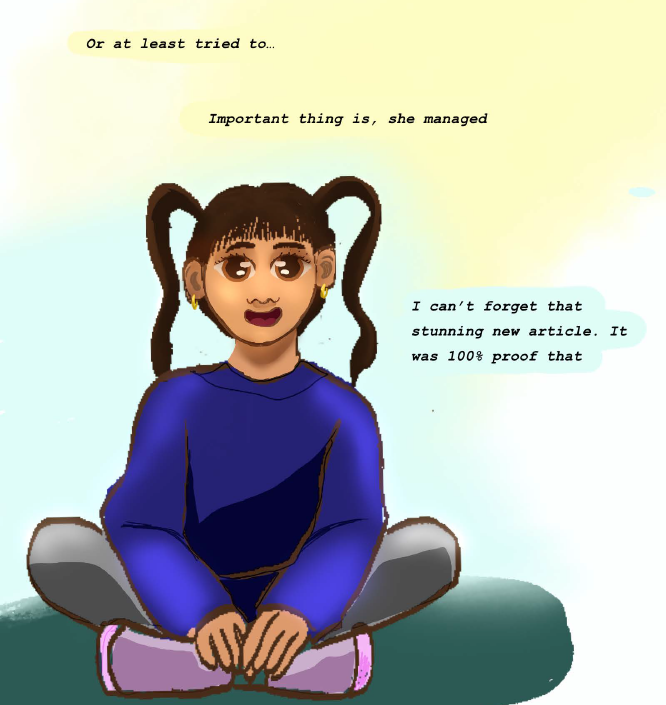 |
The Social Construction of Race, Explained Through ComicsSarrenah Ahmad's ComicSarrenah's illustrated comic uses a personal, conversational style to walk readers through the social construction of race and racism. Opening with Carl Linnaeus's deeply biased racial taxonomies - published, she points out, at the peak of the transatlantic slave trade - she then draws on a childhood memory of being fooled by a fake Wikipedia article to show how easily false "science" shapes what we believe. The comic moves through key definitions of race and racism, explains why genetic variation is greater within groups than across them, and ends by asking: if biological race isn't real, why do we keep making it matter? |
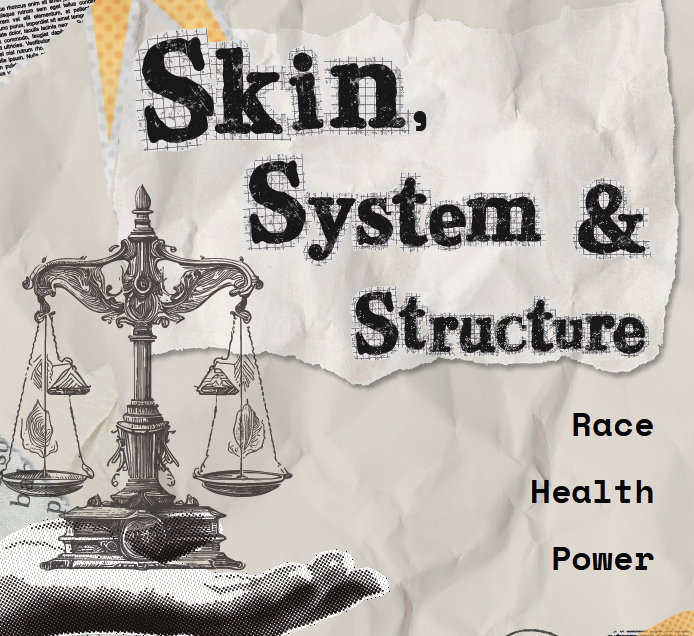 |
How Racial Myths Produce Real InequalitiesSkin, System & Structure by Christy GendyA visual anthropology project exploring how race is socially constructed and how those constructions produce real inequalities in health, education, justice, and opportunity. Moving through topics like the myth of race and athletic ability, the eugenic roots of intelligence testing, Indigenous over-incarceration, environmental racism in Canada, ancestry testing, and diversity in universities, the scrapbook challenges biological myths about race while showing how systems of power generate and sustain racial disparities. Race, Christy argues, is not just biology - it is a social system with material consequences. |
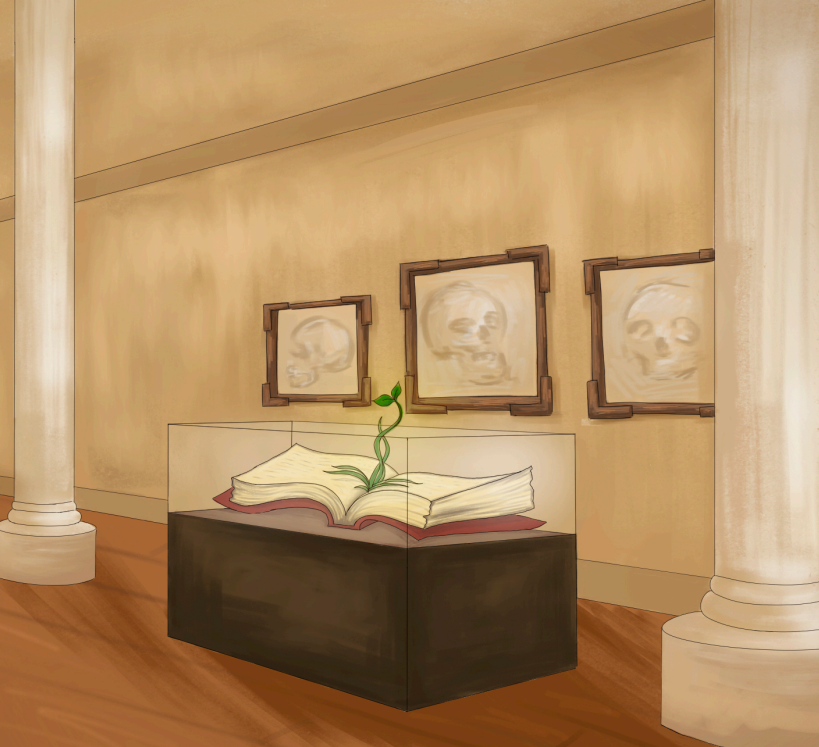 |
Art as Resistance to Scientific RacismRedefining Race by Shanshan Ma-ZhangTwo digital artworks, each accompanied by a written and audio artist statement, exploring the course's central argument that race is not a biological truth but a system invented by those in power and preserved through institutions. In Redefining Race, a vivid green plant breaks out of a museum display case holding an antique book, surrounded by muted skull paintings referencing craniometry and scientific racism - the lone burst of colour symbolizing growth and the possibility of dismantling inherited frameworks. In The Candle, a lone figure lights a worn, melted candle in darkness, the flame becoming a metaphor for all the communities who continue to resist and survive despite institutional harm, carrying forward a light that refuses to go out. See Image | See Artist Statements | Artist Statement (audio version) | Description (audio version) |
 |
Educational Games for AnthropologyGames & Activities by Madison Louise CrosbyMadison created a new interactive game each week throughout her Anthropology course to help classmates review and retain course material. Each game uses a different format - from froggy jump quizzes and crosswords to word searches, flashcards, and a final Jeopardy board. Play Body, Sex & Society Quiz | Play Socialities of Distress Matching Game | Play Bodies, Power & Health Crossword | Play Peer Support & Care True or False | Play Lesson 7 Flashcards | Play Indigenous Health & Medical Tourism Unscramble | Play Eduardo's Journey Word Search | Play Genes, Health & Identity Memory Match | Play Kahoot Review | Play Final Jeopardy Board |